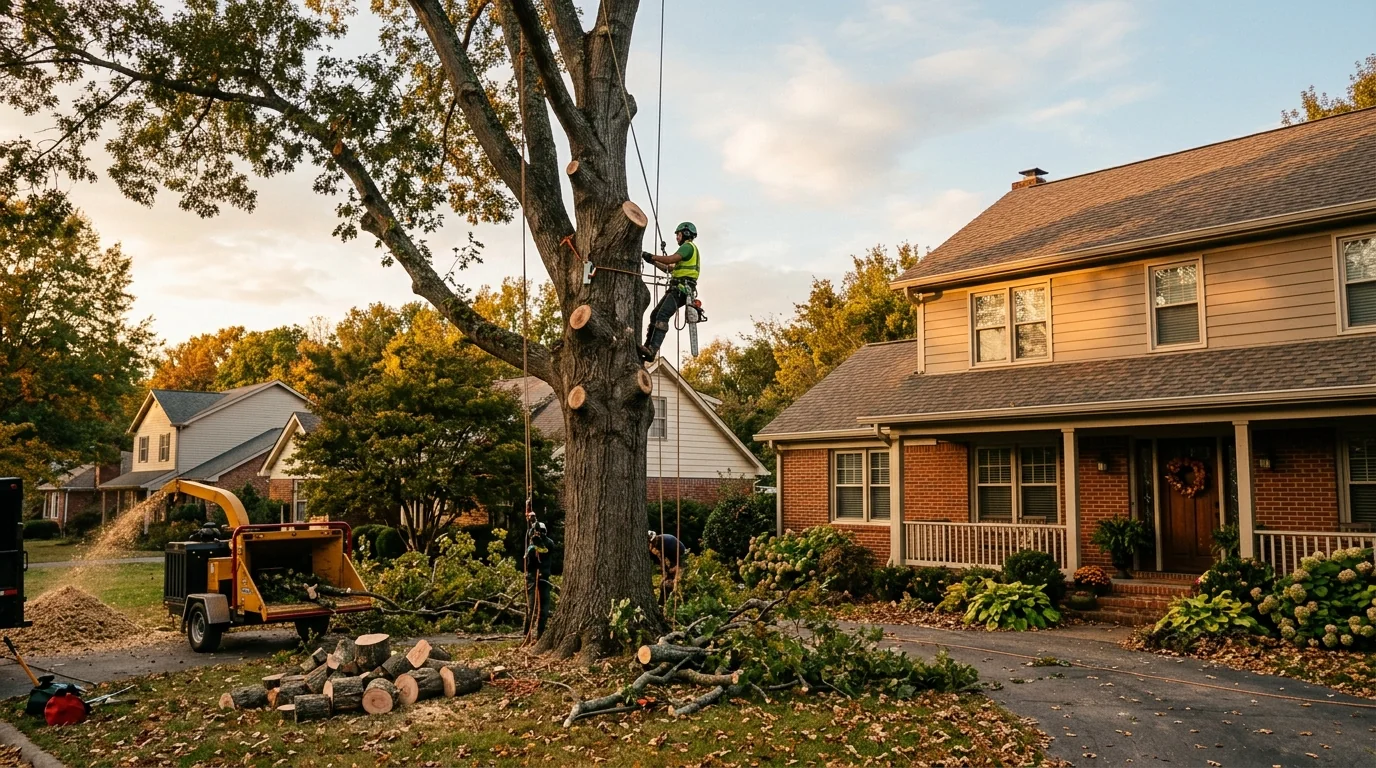
Tree Removal Permit Guide for Knoxville TN Homeowners
Most Knoxville homeowners do not need a city permit to remove a tree on private property, but Knox County zoning rules, HOA covenants, and utility right-of-way restrictions can all require approval before any chainsaw touches bark. Trees in a public right-of-way always need permits. Check your deed and HOA docs first.
Updated Jul 14, 2025 · 6 min read
Do You Need a Tree Removal Permit in Knoxville?
Most Knoxville homeowners can remove a tree on their own private property without pulling a city or county permit. That said, three situations consistently require approval before work begins: the tree sits inside a public right-of-way, your parcel falls under a Knox County planned development or overlay zone, or your neighborhood HOA covenant requires written sign-off. Getting this wrong can mean fines, forced replanting, and project delays that cost more than the removal itself.
When a Permit Is (and Is Not) Required
Private Property, Standard Residential Lots
The City of Knoxville does not currently operate a blanket street-tree ordinance that governs every residential removal. For most single-family lots in Knox County outside a special overlay, you can hire a contractor and proceed. The key word is “most.” If your property was platted as part of a planned unit development, subdivision with a tree-preservation covenant, or a riparian buffer zone along one of Knox County’s many creek corridors, different rules apply.
Before you assume you are in the clear, look up your parcel on the Knox County Property Viewer and cross-reference with Knox County Zoning (reachable at 865-215-2500). A five-minute call can confirm your status.
Public Right-of-Way Trees
Any tree rooted inside the public right-of-way, which typically extends 10 to 15 feet back from the street curb, belongs to the municipality, not the homeowner. Removing or substantially pruning one of these trees without city approval is illegal and can result in a replacement fine equal to the appraised value of the tree. Contact the City of Knoxville Public Works Department before touching any tree that sits between your sidewalk and the street.
HOA-Governed Communities
Approximately 45 percent of suburban Southeast homes sit inside an HOA, and the majority of those require written approval for any tree removal visible from the street. Your CC&Rs (the Covenants, Conditions, and Restrictions recorded with Knox County Register of Deeds) will spell out the exact process. Some boards require an arborist letter; others just ask for a form. Either way, get written approval and keep a copy before work begins.
Special Overlay Zones and Greenway Buffers
Knox County’s greenway corridors, floodplain edges, and certain historic overlay zones carry their own tree canopy requirements. If your property backs up to Third Creek Greenway, Beaver Creek, or any named tributary, a 50-foot or wider riparian buffer may restrict what you can remove without a mitigation plan. Check with Knox County Engineering or the City of Knoxville Stormwater Department if your lot borders water.
How to Apply for a Tree Removal Permit in Knox County
- Identify your jurisdiction. Determine whether your address falls under City of Knoxville limits or unincorporated Knox County. Each has separate contacts and processes.
- Gather parcel information. Pull your tax parcel number from the Knox County Property Assessor site. Have your deed and any subdivision plat handy.
- Contact the right office. For unincorporated Knox County, call Knox County Zoning at (865) 215-2500 or visit the Development Services office at 400 Main Street, Suite 425. For city-limit properties near right-of-way trees, contact City of Knoxville Development Services at (865) 215-2084.
- Submit a site plan if required. Most reviewers want a simple sketch showing the tree’s location relative to the property line, the street, and any structures. Note the species and approximate trunk diameter.
- Wait for written approval. Processing for straightforward requests typically runs one to two weeks. Urgency because of storm damage or a confirmed hazard can sometimes accelerate review if you include an ISA-certified arborist’s written assessment.
- Keep your permit on site. Once approved, post or keep the paperwork accessible during the job. Inspectors can ask to see it.
Knoxville-Specific Factors That Complicate the Picture
Ice Storms and Emergency Removals
East Tennessee’s elevation and its position in the Valley and Ridge province make it particularly vulnerable to winter ice storms. The February 2021 ice event caused widespread limb failure across Knox County’s white pines and hardwoods. When a tree is actively threatening a structure, Knox County and city staff typically have emergency provisions that allow expedited or after-the-fact permit review. Document the hazard with photographs and get an arborist’s assessment in writing even if the job cannot wait (NOAA Storm Events Database records multiple Knox County ice events in the past decade).
Dead Trees and Disease-Driven Removals
Knoxville carries a uniquely heavy tree-disease burden. Emerald Ash Borer has been confirmed in Knox County, and affected ash trees die within three to five years, becoming brittle hazard trees (Tennessee Department of Agriculture, EAB Quarantine and Pest Alert). Thousand Cankers Disease was first detected in the eastern United States in Knoxville in July 2010, putting local black walnuts at elevated mortality risk (University of Tennessee Extension W-277). Hemlock Woolly Adelgid has devastated eastern hemlocks throughout the adjacent Smoky Mountains region (USDA Forest Service). Any of these diseased trees on your property may qualify for expedited hazard review if you have documentation, but do not assume the disease exempts you automatically. Ask first.
Karst Soils and Root System Concerns
Knox County’s karst limestone geology means subsurface voids exist under many residential lots. When reviewers assess a tree removal near a structure, they sometimes ask about root systems that may be stabilizing slopes above these cavities. If your tree sits on a hillside or near a drainage swale, mention this proactively so the reviewer can flag any site-specific concerns before your contractor mobilizes (USDA Web Soil Survey, Knox County; Tennessee Geological Survey karst mapping).
The Right-of-Way Trap
Knoxville’s older in-town neighborhoods, including Fourth and Gill, Parkridge, and Inskip, frequently have mature oaks and maples rooted partly in the right-of-way. Homeowners sometimes assume the tree is “theirs” because it is adjacent to their yard. A quick look at your GIS plat will settle the question. When in doubt, treat the tree as a public asset until the city confirms otherwise.
What This Means for Your Project
Understanding the permit landscape before you hire a contractor saves you money and avoids project shutdowns. A reputable tree service operating in the Knoxville area will ask about your HOA status and lot type before quoting. If a contractor tells you permits are “never required” without asking about your specific parcel, treat that as a yellow flag.
If you have a diseased, dead, or storm-damaged tree, the urgency is real, but so is the liability exposure from skipping proper channels. See the full breakdown of tree removal costs in Knoxville to understand what permit fees, arborist assessments, and contractor quotes typically add up to. For questions about whether your tree qualifies as a hazard or can be saved instead of removed, the tree problems and diagnosis hub covers the decision framework in detail.
When you are ready to move forward, the fastest path is to have your parcel number and a photo of the tree ready, confirm your permit status with the appropriate office, and then request quotes from licensed Knoxville tree services who can handle the job from assessment through cleanup.
For a broader look at what services local contractors offer, the tree services overview lists the full scope of work, from single-tree removals to crane-assisted jobs on tight lots. ISA-certified arborists can be verified directly through the International Society of Arboriculture’s find-an-arborist tool, which is worth checking before any contractor visits your property.
Free written estimate
Worried about a tree? Get a free estimate.
On-site assessment and a written estimate. Same-day for emergencies. No obligation.
Questions
Tree Removal Permit Guide for Knoxville TN Homeowners FAQs
Do I need a permit to remove a tree in Knoxville, TN?
How do I apply for a tree removal permit in Knox County?
What happens if I remove a tree without a required permit?
Does my HOA have to approve tree removal in Knoxville?
Are dead or hazard trees exempt from permit requirements?
Who is responsible for a tree that falls from my yard onto a neighbor's property?
Does a permit cover stump removal too?
Free estimate
Talk to a Knoxville tree pro
On-site assessment and a written estimate, often same day. No obligation.