Service area · Tennessee
Tree care in Eagleton Village
Eagleton Village is a census-designated place in Blount County, Tennessee, with a population of roughly 5,300 residents. The community grew rapidly during and after World War II as workers arrived to support the nearby ALCOA plant, producing a housing stock that now carries decades of mature tree growth. That canopy is an asset and a liability during the region's frequent severe weather seasons.
Why Eagleton Village Tree Removal Is Different
Eagleton Village occupies a specific niche in the Knoxville metro: a community that urbanized fast during World War II and never stopped adding canopy. The Wikipedia entry for Eagleton Village notes that growth was driven by workers arriving for the ALCOA plant, which means the oldest residential blocks date to the 1940s and carry 80-plus years of unmanaged tree growth. That history shapes almost every tree removal job in the area, from the species mix to the proximity of large root systems to older foundations.
Soil and Geology in Blount County
Eagleton Village sits in the Ridge and Valley physiographic province of East Tennessee, the same geologic setting that governs neighboring Alcoa and the Maryville area. Soils in this zone tend to alternate between thin residual soils over limestone and dolomite and deeper alluvial deposits near creek and river bottomlands. The Little Tennessee River corridor, which borders portions of Blount County’s developed areas, introduces floodplain soils that hold moisture longer after rainfall events. Trees rooted in waterlogged bottomland soils are more prone to windthrow because saturated ground reduces root anchorage. Contractors working in Eagleton Village need to account for this variability rather than applying a uniform risk assessment across the entire community.
Climate and Storm Risk
The Knoxville metro sits within a documented severe-weather corridor. The NOAA Storm Events Database records tornado touchdowns, straight-line wind events, and ice storms across Blount County on a recurring basis. Spring severe weather runs March through May. Summer thunderstorms bring microburst wind shear in June, July, and August. Tropical systems weakened by inland travel can still deliver damaging winds through September and October. Winter ice storms are less frequent but are particularly destructive to older deciduous trees because ice loading on a full canopy can snap major limbs or topple root systems already compromised by disease or drought stress.
For Eagleton Village homeowners, the practical implication is that a tree that looks manageable in September may become a same-day emergency removal in March. Staying ahead of obvious hazards before storm season is a much cheaper outcome than emergency work after the fact.
Housing Era and Canopy Age
The WWII-era construction wave produced homes with modest lot footprints and trees planted close to structures. What was a six-inch sapling in 1948 is now a 70-foot oak or tulip poplar with a trunk diameter that can exceed 24 inches. At that scale, removal costs climb significantly. According to Bob Vila’s tree removal cost guide, large trees commonly run between $800 and $1,500 or more depending on access and condition, while crane-assisted removals near structures can push well beyond that range. Homeowners in the older ALCOA-corridor blocks should budget for the upper end of cost ranges when planning removal of mature trees.
Eagleton Village Neighborhoods and Tree Removal Patterns
The community’s growth pattern created distinct pockets with different canopy ages, lot sizes, and access constraints. Understanding which neighborhood a property sits in helps set realistic expectations about access, equipment requirements, and likely species.
- ALCOA Corridor. The oldest residential concentration in Eagleton Village. Lots are tight, trees are large and often planted within 10 feet of foundations or rooflines.
- Eagleton Heights. Mid-century subdivision stock with a mix of mature hardwoods. Overhead utility lines run through many backyards, complicating removal logistics.
- West Eagleton. Slightly newer development with more slab-on-grade construction. Canopy is younger but Bradford pear and pine species are common removal candidates.
- South Blount Estates. Larger lots with better equipment access. Crane staging is generally feasible, which controls cost on oversized trees.
- Topside Road Area. Mixed residential density along a primary connector road. Storm-damaged trees near the road right-of-way are a recurring call driver here.
- Little Tennessee Bottomland. Properties near the river corridor carry floodplain soils. Windthrow risk is elevated after prolonged wet periods. Root systems are often shallower than homeowners expect.
- U.S. 129 Frontage District. Commercial and residential mix. Trees near the highway corridor are subject to utility easements that affect what removal methods are permitted.
- North Eagleton Residential. Infill construction from the 1980s and 1990s. Canopy is moderate; pine bark beetle and oak decline are the most common problem drivers.
- East Eagleton Subdivisions. The newest residential growth area. Younger trees dominate but poorly selected species planted at construction are beginning to create structural conflicts with driveways and foundations.
How to Find an Eagleton Village Tree Removal Contractor
The Knoxville metro has no shortage of tree services advertising availability, but Eagleton Village’s specific conditions narrow the field of genuinely qualified contractors. Four criteria matter most when evaluating bids.
Verifiable credentials, not just a license number. An ISA Certified Arborist credential is the baseline professional standard for anyone diagnosing tree health or recommending removal. The International Society of Arboriculture’s Find an Arborist tool lets you verify credentials by name or certificate number before you agree to anything. The Tree Care Industry Association’s hiring guide explains what TCIA accreditation adds beyond a basic ISA credential. In a market where 49 percent of homeowners have received conflicting save-vs-remove recommendations from different contractors, credential verification is the fastest way to filter out unqualified opinions.
Documented local experience in Blount County. A contractor who regularly works Eagleton Village and the surrounding Alcoa-Maryville area will know the local utility easement protocols, the soil conditions near the river bottomlands, and the species mix driving most calls. Ask specifically for references from jobs in this zip code or adjacent ones. Generic Knoxville-area experience is not the same as familiarity with the tight lot constraints in the ALCOA corridor.
Written scope covering debris and haul-off. Seventy-one percent of homeowners expect debris removal to be included in the base quote. Get the haul-off scope in writing before work begins. Contracts that leave haul-off as an optional line item frequently generate post-job disputes. A reputable contractor states exactly what leaves the property and what does not.
Insurance documentation you can verify. Request a certificate of insurance showing current general liability and workers’ compensation coverage. Call the carrier to confirm the policy is active. In Blount County’s unincorporated areas, there is no municipal licensing database to cross-reference, so independent insurance verification is the primary consumer protection available.
What to Expect from an Eagleton Village Inspection
A thorough pre-removal inspection covers four distinct areas. Any contractor who quotes a job without completing all four is working from incomplete information.
Exterior walk-around. The arborist assesses trunk lean, visible decay, bark damage, crown dieback, and proximity to structures, utility lines, and property lines. For ALCOA-corridor homes where trees may be within a few feet of the roofline, this step also identifies whether crane access is feasible from the street.
Interior walk-through. Cracks in walls, sticking doors, and uneven floors can indicate root pressure on a foundation or significant soil movement. While an arborist is not a structural engineer, documenting these signs during the inspection creates a baseline record useful for homeowners considering foundation-risk tree removal services.
Crawl-space or foundation perimeter check. Older pier-and-beam homes in the ALCOA corridor are particularly vulnerable to root intrusion near the foundation perimeter. The inspector checks for exposed roots, soil displacement, and moisture intrusion near the base of the structure.
Slope and floodplain assessment. Properties near the Little Tennessee River bottomland warrant a site-specific assessment of soil saturation and slope stability. A tree that passed a visual inspection in a dry August may present a genuine windthrow hazard after a wet spring. The inspector should note the proximity to any designated floodplain and whether that affects equipment staging or haul-off routing.
Repair Methods Used Most Often in Eagleton Village
The most common service calls in Eagleton Village follow a predictable pattern shaped by the community’s age and canopy density. The following methods are listed in rough order of frequency.
- Full tree removal. The primary service for dead, storm-damaged, or structurally conflicted trees in the ALCOA corridor and older subdivisions. For most residential sizes, Bob Vila reports costs ranging from $385 to $1,070, with large trees well above that range. See the full tree removal cost breakdown for size-based estimates.
- Emergency storm removal. High-volume call driver after spring and summer severe weather. Emergency removals carry a cost premium above standard rates due to after-hours response and priority scheduling. Review emergency tree removal options before the next storm season.
- Stump grinding. Roughly 62 percent of removal jobs include stump grinding as a line item. Bob Vila cites typical stump grinding costs in the $100 to $400 range depending on stump diameter. Explore stump grinding service details for what the process covers.
- Crown reduction and hazard pruning. For trees that are worth saving but pose specific hazard risks from overextended limbs, crown reduction reduces load without full removal. The ANSI A300 pruning standard, maintained by the Tree Care Industry Association, governs best-practice cuts.
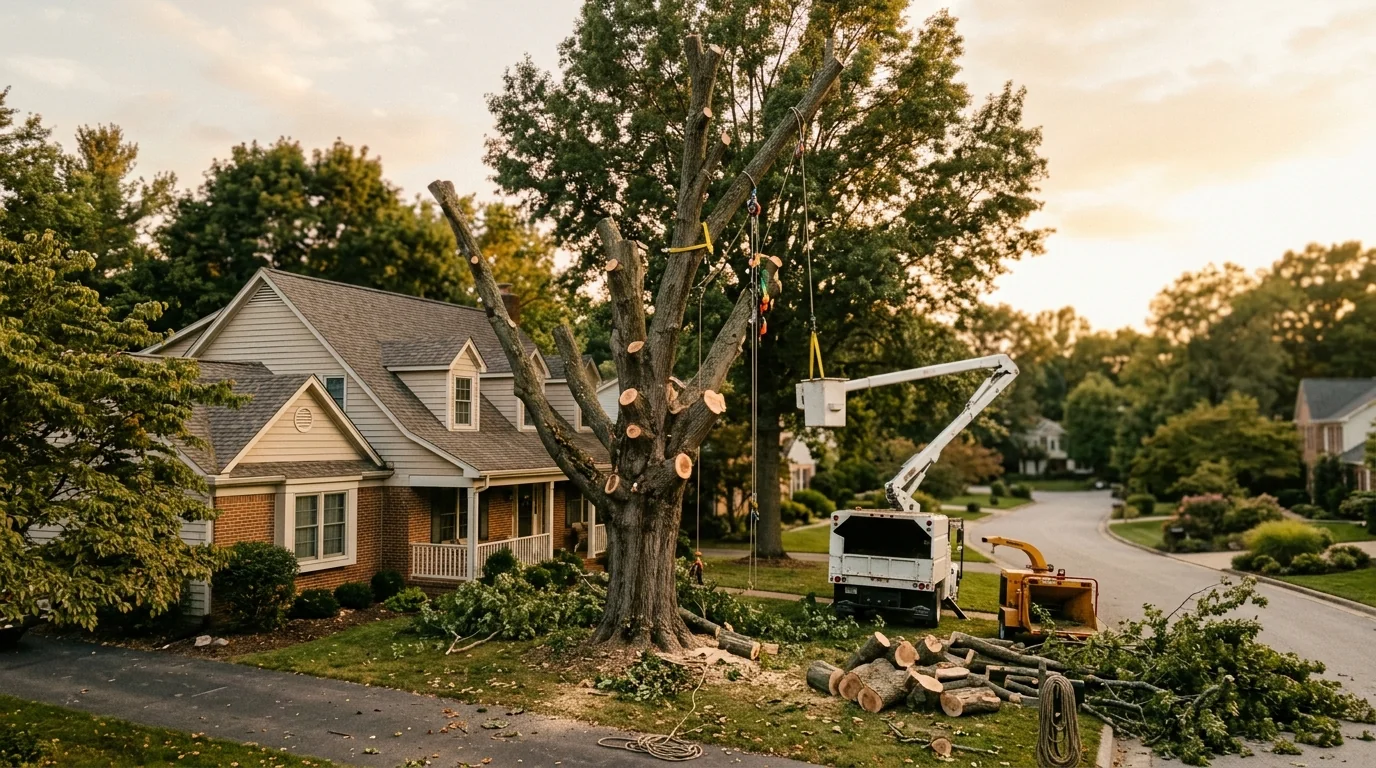
- Crane-assisted removal. Required when a tree is positioned over a structure with no clear felling zone. Tight lots in the older Eagleton Village blocks frequently require crane staging. Bob Vila notes crane-assisted removals commonly run $500 to $1,000 or more above standard removal cost. See crane-assisted tree removal pricing for Knoxville-area context.
For a full overview of available services, visit the tree services hub.
Eagleton Village Building Permits
Eagleton Village is a census-designated place, not an incorporated municipality. There is no city hall or city planning department. Permitting authority rests with Blount County, and homeowners should contact the Blount County Planning Department directly to confirm current requirements before any tree removal on property that borders a public right-of-way, utility easement, or stream buffer.
For routine removal of trees on private residential property well away from public ROW, Blount County historically has not required a standard tree removal permit. That said, requirements can change, and properties within designated floodplain zones or adjacent to TDOT-managed corridors like U.S. Route 129 may face additional review. Utility-corridor trees touching TVA or local electric cooperative lines require coordination with the relevant utility before work begins, regardless of permit status.
Tennessee adopted the 2018 International Building Code as its statewide baseline. Blount County enforces this through its building inspections office. If a tree removal is part of a larger construction or grading project, a land disturbance permit may be required separately from any tree-specific authorization. Confirm both with the county before mobilizing equipment.
Other Tennessee Cities We Serve
Eagleton Village sits within the Knoxville metro, and the same contractor network covers the surrounding communities. If you need service in a neighboring area, start with the relevant location page.
- Tree removal services in Alcoa, TN covers the adjacent Alcoa city limits and the industrial corridor properties that share a zip code with Eagleton Village.
- Tree removal in Rockford, TN serves the rural-residential properties to the south in Blount County, where larger lots and river-bottom soils create a distinct set of canopy challenges.
- Tree removal in Knoxville, TN is the anchor market for the regional network, with a full crew roster available for same-day emergency response across Knox County.
Ready to schedule an assessment? Request a free inspection quote and a local arborist will contact you to arrange a site visit at no cost and with no obligation.
For a full breakdown of what removal will cost before you commit, review the tree removal cost guide covering size, species, and access variables that apply across the Blount County market. If you want to understand which tree problems are driving the most calls in this area, the common tree problems guide covers the species and conditions most relevant to East Tennessee.
Neighborhoods served
Eagleton Village neighborhoods
- ALCOA Corridor
- Eagleton Heights
- West Eagleton
- South Blount Estates
- Topside Road Area
- Little Tennessee Bottomland
- U.S. 129 Frontage District
- North Eagleton Residential
- East Eagleton Subdivisions
Questions
Eagleton Village tree care FAQs
Why are tree problems so common in Eagleton Village?
How much does tree removal cost in Eagleton Village?
Do you need a permit to remove a tree in Eagleton Village?
How do I check a contractor's history in Eagleton Village?
Which Eagleton Village neighborhoods tend to have the most tree work?
Are free inspections available in Eagleton Village?
Free estimate
Free Eagleton Village tree estimate
On-site assessment, written quote within 24 hours, no obligation.