What is lot clearing and when is it the right choice?
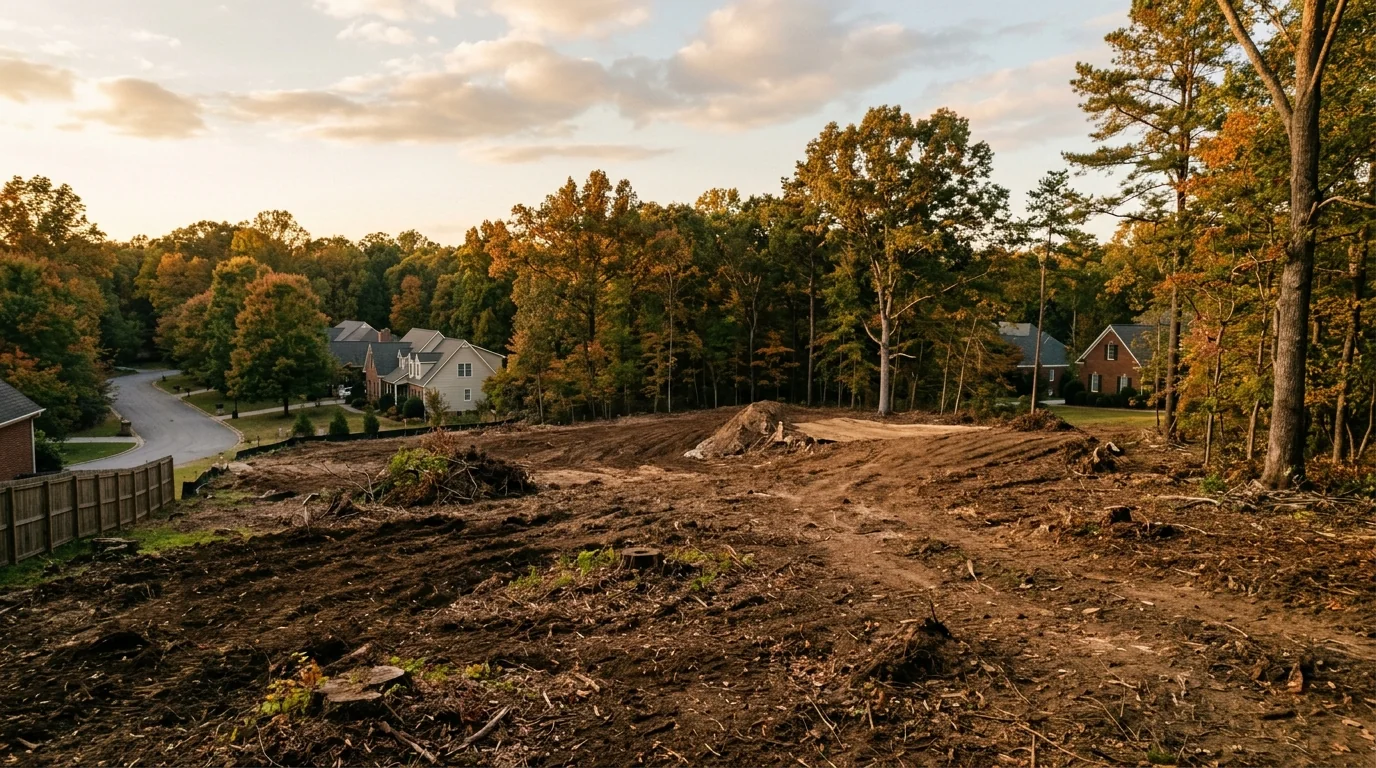
Lot clearing is the complete removal of all trees, brush, stumps, and woody debris from a parcel of land, typically to prepare the site for construction, a new driveway, a fence line, or a landscaping reset. Unlike taking down a single problem tree, lot clearing is a ground-up operation that leaves the parcel free of all above-ground and near-surface woody material. In the Knoxville metro, where lots often carry decades of mixed hardwood growth, vine tangles, and brush understory, a lot clearing project is a multi-phase mobilization rather than a simple tree job.
The right moment to choose full lot clearing over selective removal is when the end goal requires a clean slate. Building a new home, setting a foundation, installing a septic system, or converting a wooded parcel to usable lawn all demand that every stump, root mass, and brush clump be addressed before grading begins. Attempting to work around standing trees or skipped stumps introduces settlement voids under footings and complicates every contractor who follows.
How lot clearing works mechanically
Crews begin with hand felling or machine felling of standing trees, moving from the largest-diameter specimens outward to the perimeter. A chipper handles brush and limbs in real time. Stumps are ground to a depth specified by the landowner or the engineer of record, typically 12 inches or more below grade on construction sites. A tracked skid steer or small excavator rakes the surface to collect root balls and debris, and a haul truck removes material that cannot be chipped on site. The sequence matters: felling before chipping, grinding before raking, raking before any grading equipment arrives.
Lot clearing fits when the entire parcel needs to change use. Common triggers in Knox County include infill residential construction on previously wooded lots, subdivision development on acreage tracts in the Corryton, Mascot, and Powell corridors, conversion of overgrown inherited property, and remediation after storm events that have damaged the majority of the canopy. The September 2024 remnants of Hurricane Helene caused widespread saturation-driven tree failures across East Tennessee, leaving some Knox County properties with so many compromised trees that selective removal was no longer practical.
Conditions where selective removal is the better choice
If the goal is removing one hazard tree, a small cluster of dead ash trees killed by Emerald Ash Borer, or a Bradford pear that has outgrown its space, selective tree removal in Knoxville is the more precise and cost-effective path. Selective removal preserves established canopy, avoids the permit complexity of full land disturbance, and costs substantially less when only a handful of trees are involved. It is also the preferred approach when 64 percent of homeowners want to save as much canopy as possible, per residential survey data on tree service preferences.
Installation process
The timeline below reflects a typical residential lot clearing project in Knox County of one-quarter to one-half acre with mixed hardwood cover. Larger parcels scale proportionally.
Day 1, site walk and layout
The crew foreman walks the parcel with the property owner to mark any trees flagged for preservation, confirm utility locates (Tennessee 811 should be called at least three business days before any ground disturbance), and identify access points for equipment. Equipment is staged: typically a chipper, a tracked skid steer or compact excavator, and a haul truck. Access matters here, Knox County ridge lots and sites with steep driveways may require smaller tracked equipment that takes longer per acre than rubber-tired machines working on flat terrain.
Day 1 to 2, felling and chipping
Chainsaw operators fall trees in a planned sequence, working outward from the interior of the lot. Limbs are fed to the chipper continuously. Large-diameter hardwoods common in Knoxville (white oak, red oak, hickory) take longer to process than pine or poplar. Logs too large for the chipper are bucked into sections and set aside for haul-out or firewood splitting per the owner’s preference. Most residential lots reach this phase completion by the end of day two.
Day 2 to 3, stump grinding
A dedicated stump grinder follows the felling crew. Each stump is ground to the specified depth. For construction sites, 12 inches below finish grade is the common minimum. For lawn conversion, 4 to 6 inches is typically sufficient for seeding or sod. The grinder produces a significant volume of wood chips and soil mix that is raked level or hauled depending on whether the owner wants it as fill.
Day 3 to 4, debris raking and haul-off
The skid steer rakes the cleared surface to collect remaining root masses, small stumps missed by the grinder, and surface debris. Haul trucks remove chip piles and log sections. On sites with karst limestone close to the surface, a defining characteristic of Knox County geology, the operator watches for subsurface voids exposed by root removal. Any void encountered should be flagged for a geotechnical review before grading.
Day 4 to 5, final cleanup and site handoff
The crew does a final walk, confirms stump depths with a probe, removes equipment, and prepares documentation for permit close-out if required. The site is now ready for a grading contractor.
Lot clearing vs. selective tree removal
The choice between clearing a full lot and removing individual trees is primarily a question of end use, not cost efficiency. Full lot clearing carries higher upfront costs and greater permit complexity, but it eliminates every obstacle for the next contractor in a single mobilization. Selective removal preserves canopy and costs less per tree, but each remaining tree and stump becomes a constraint for any future grading or construction.
In practice, lot clearing is the right answer when more than roughly 60 to 70 percent of the canopy needs to go anyway. At that density of removal, the per-tree cost of selective work plus repeated mobilization fees approaches or exceeds the project price of a full clearing crew. The math tips toward clearing even faster on steep Knox County sites where equipment setup costs are high relative to production time.
Selective removal holds its advantage when the property has established specimen trees worth keeping, when neighbors or an HOA have visual interests in the existing canopy, or when only a corridor (say, a driveway path or a fence line) needs to be opened. Review the selective tree removal service page to compare the two approaches in detail before committing to a scope.
One honest edge case for lot clearing: on parcels with known Thousand Cankers Disease pressure on black walnut, or with multiple ash trees already dead from Emerald Ash Borer, the infected material needs to leave the site regardless. That sometimes tips a borderline property into full clearing because the diseased trees that need to come down are scattered throughout the lot.
Lot clearing cost in Knoxville, TN
According to Bob Vila’s land clearing cost guide, full lot clearing averages roughly $1,500 to $3,000 per acre nationally, with tree-heavy or difficult-access sites running higher. This Old House’s 2026 tree removal pricing guide confirms that individual tree removal runs $300 to $1,000 per tree on average, which illustrates why per-tree pricing becomes inefficient once a project involves dozens of trees.
Local variables that move the number in Knox County specifically:
Terrain and slope. Knox County’s Valley and Ridge topography means many residential lots have meaningful grade changes. Steep slopes require tracked equipment rather than wheeled machines, which is slower and more expensive. Equipment that cannot reach the site without a road cut adds mobilization cost before any tree is felled.
Karst conditions. The karst limestone bedrock underlying much of Knox County creates the possibility of subsurface void exposure during stump grinding and root raking. If a void is encountered, work pauses pending geotechnical review. That is not a billable surprise from a reputable contractor, but it does extend the timeline and may require additional grading fill.
Tree species and diameter. Hardwood-dominated lots (white oak, red oak, shagbark hickory) take longer to process than pine or poplar stands. Large-diameter hardwoods slow both felling and chipper throughput. A half-acre lot of mature oaks will cost more to clear than a half-acre of young mixed pine even at the same acreage rate.
Stump grinding depth. Construction-grade stump grinding (12 inches or deeper) costs more than lawn-grade (4 to 6 inches). Confirm the depth specification in writing before signing the contract.
Debris haul-off. Chip piles and log sections remaining on site are a negotiable line item. Haul-off is almost always worth including rather than coordinating a separate disposal contractor.
For a site-specific number, request a lot clearing quote for your Knoxville property with parcel size, approximate tree count, and end use noted. See the full lot clearing cost breakdown for Knoxville for a deeper look at the pricing model.
Warranty and transferability
A strong lot clearing warranty covers two things: workmanship (the crew completed the work to the specified scope and depth) and stump regrowth treatment (cut stumps were treated with a systemic herbicide or mechanical barrier to prevent resprouting). The workmanship warranty should be in writing, minimum one year, and should specify the stump grinding depth that was guaranteed.
Transferability is less commonly applicable to lot clearing than to structural repairs because the work is typically completed before a structure exists. If the parcel is being sold after clearing, request documentation of stump depths and any herbicide applications for disclosure to the buyer and the grading contractor.
Ask any contractor the following before signing: What is the grinding depth guarantee? What happens if a stump sprouts within 12 months? Is the workmanship warranty tied to the individual crew or the company? Reputable companies answer all three without hesitation.
Permits and engineering in Knox County
Lot clearing in the Knoxville metro almost always triggers permitting requirements at one or more levels.
Knox County land disturbance permit. Knox County Engineering and Public Works requires a land disturbance permit for grading or clearing that disturbs more than 10,000 square feet of land (roughly one-quarter acre). The permit requires a site plan showing drainage controls, typically a silt fence perimeter, and may require a stormwater pollution prevention plan for larger parcels. Applications are submitted to Knox County Engineering at 400 Main Street, Suite 353, Knoxville, TN 37902.
City of Knoxville Urban Forestry ordinance. Properties within the City of Knoxville city limits are subject to the Urban Forestry ordinance, which requires permits for removal of trees meeting diameter thresholds on regulated property types. The City’s Urban Forestry Division reviews applications and may require mitigation planting for significant canopy removal. This layer applies in addition to, not instead of, the county land disturbance permit for sites within city limits.
TDEC NPDES construction permit. Projects disturbing one acre or more must obtain coverage under the Tennessee Department of Environment and Conservation’s Construction General Permit (NPDES CGP) before ground disturbance begins. This applies to most subdivision-scale lot clearing projects.
Utility locates. Tennessee law requires notification to Tennessee 811 (call 811) at least three business days before any ground disturbance. This is non-negotiable regardless of permit status.
For properties in the city limits, the Knoxville Urban Forestry Division is the first call for confirming which trees on your specific parcel are regulated before signing a clearing contract. Knowing the regulatory status of specimen trees before mobilization avoids costly stop-work orders. Working with a crew that understands Knox County’s karst geology, steep terrain, and dual-jurisdiction permit environment is the most direct way to keep a lot clearing project on schedule.
If you are ready to move forward, request a lot clearing estimate for your Knoxville parcel and include the parcel address, approximate acreage, and intended end use so the estimator can flag the applicable permit requirements before the crew arrives.