Service area · Tennessee
Tree care in Karns
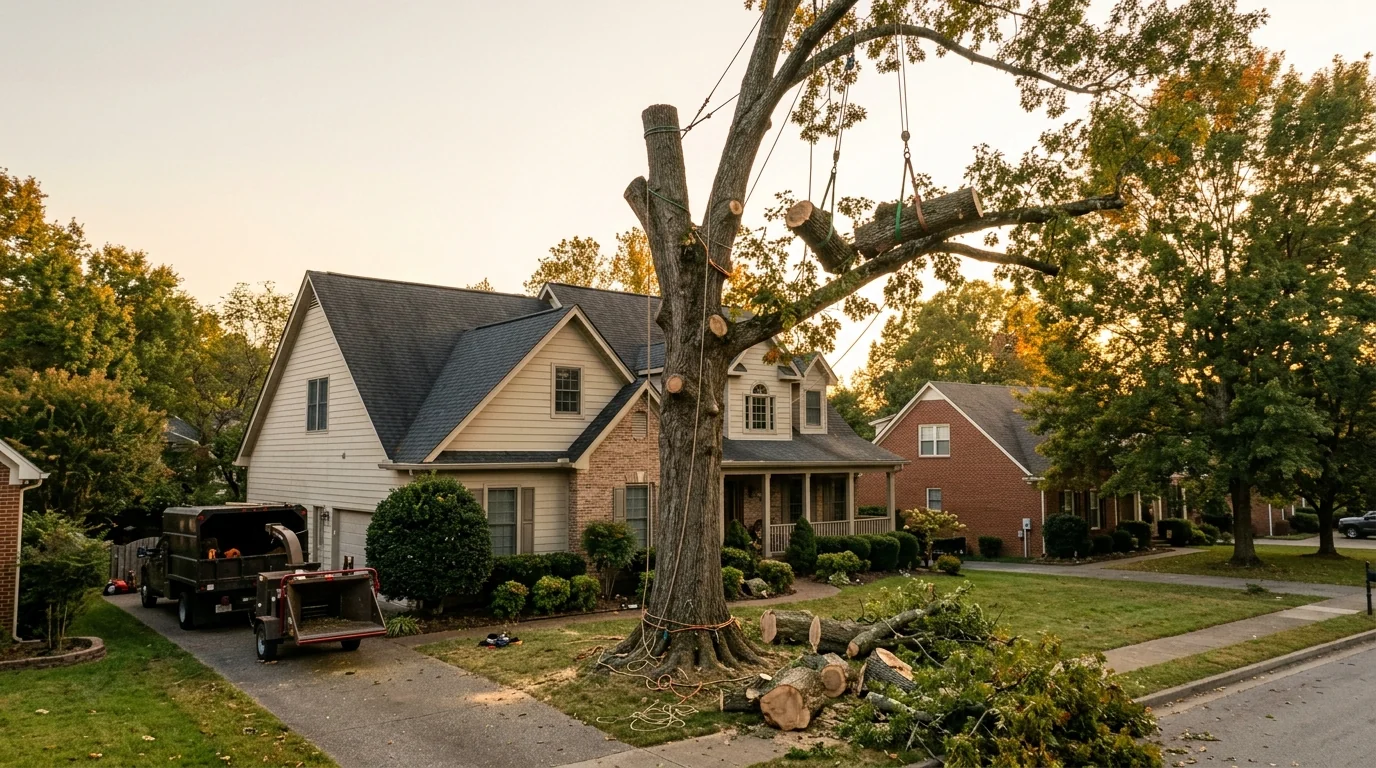
Karns is an unincorporated community in northwest Knox County, Tennessee, about 11 miles from downtown Knoxville. The area features mature suburban canopy, rolling terrain, and a housing stock that ranges from mid-century ranch homes to newer subdivisions. Storm seasons drive significant emergency tree removal demand across the community.
Why Karns Tree Removal Is Different
Karns sits in northwest Knox County, roughly 11 miles from downtown Knoxville, as an unincorporated community without city-level code enforcement or a municipal urban forestry program. That jurisdictional status shapes nearly every aspect of tree work here. Homeowners deal directly with Knox County rather than a city planning department, and the community’s rolling terrain, dense mature canopy, and mix of housing eras create a set of conditions that contractors unfamiliar with the area routinely underestimate. Understanding those conditions before you call for a quote puts you in a better position to evaluate every crew that shows up.
Soil and Geology in Northwest Knox County
Knox County sits within the Ridge and Valley physiographic province of East Tennessee, a landscape shaped by alternating ridges of resistant sandstone and valleys underlain by limestone and shale. Soils in the Karns area tend toward silty clay loams with moderate to poor drainage in low spots. That clay content matters for tree stability. During wet seasons, saturated soils lose their grip on root systems, and trees that looked solid during a dry summer can lean or topple after two weeks of rain in March. The USDA Forest Service notes that urban tree root systems are particularly sensitive to soil compaction and drainage changes caused by construction and impervious surface expansion. Karns has seen steady residential development over the past two decades, and compacted fill soils in newer subdivision lots can hide root problems that only become visible when a storm arrives.
Climate and Storm Exposure
East Tennessee receives significant annual rainfall, and Knox County sits in a corridor where spring severe weather systems, summer thunderstorms, and the remnants of Gulf tropical systems all intersect. The NOAA Storm Events Database documents repeated wind, hail, and tornado events across Knox County, with northwest portions of the county exposed to straight-line wind events that track along the ridge systems. Bradford pear trees, which are common in Karns subdivisions planted through the 1990s and 2000s, have a structural failure rate that spikes during these events because of their tight branch angles. Pine trees in the community are also vulnerable to lightning strikes and bark beetle pressure after drought stress. Ice events in December and February are less frequent than in higher-elevation areas but can load limbs past their breaking point on maples and oaks that have not been pruned in several years.
Housing Era and Tree Maturity
Karns developed in overlapping waves. Older sections along Karns Road and Ball Camp Pike contain mid-century ranch homes on half-acre or larger lots where foundation plantings have had 40 to 60 years to become full-canopy trees. These older trees frequently overhang rooflines, septic systems, and property lines simultaneously, which complicates removal logistics. Newer subdivisions off Beaver Ridge Road were built from the 1990s through the 2010s, where faster-growing ornamental species were planted close to structures for curb appeal and have now grown large enough to become hazards. That combination of vintage housing and aggressive ornamental plantings means Karns generates a broad range of removal scenarios, from straightforward dead-tree pulls to complex over-structure work requiring aerial rigging.
Karns Neighborhoods and Tree Patterns
Different parts of Karns present different removal challenges based on lot age, canopy density, and access conditions.
- Karns Road Corridor. Older lots with mature oaks and hickories, often with limited rear-yard equipment access due to fencing and established landscaping.
- Ball Camp Pike Area. Mix of long-established residential and light commercial properties; large pines are common and frequently cited for storm damage.
- Byington-Solway Road. Transitional zone between older farm parcels and suburban development; tree rows from old field boundaries still stand near homes.
- Beaver Ridge Road Subdivisions. Newer construction with Bradford pears and ornamental maples planted close to structures, now reaching removal age.
- Karns Cross Roads. Higher-traffic commercial intersection with adjacent residential lots; utility-line conflicts are a recurring issue here.
- Oak Ridge Highway Frontage. Properties along the highway corridor deal with right-of-way trees managed by TDOT as well as privately owned trees close to the road.
- Hardin Valley Road Edge. Active development corridor where lot-clearing work overlaps with removal of residual mature trees from earlier farm use.
- Solway Junction. Smaller residential pockets with moderate canopy; proximity to Beaver Creek drainage means wet soils and occasional root instability after heavy rain.
How to Find a Karns Tree Removal Contractor
Karns homeowners searching for tree services quickly discover that the northwest Knox County market attracts contractors from across the metro, and quality varies. Four evaluation criteria help separate capable crews from those likely to create problems.
Verify insurance before any other conversation. General liability coverage and a separate workers compensation policy are both required. A tree that falls on your house during removal, or a worker injured on your property, becomes your financial exposure if the contractor is uninsured. Ask for certificates showing current coverage and confirm the issuing insurer directly. The Tree Care Industry Association’s guidance on hiring a tree care company explains what documentation homeowners should request before signing any agreement.
Ask for ISA Certified Arborist credentials. The International Society of Arboriculture maintains a public database at treesaregood.org where you can confirm whether a named arborist holds current certification. Certification indicates the individual has passed standardized testing on tree biology, risk assessment, and proper pruning and removal technique. In a market like Karns where tree-structure failures after storms create time pressure, having a credentialed arborist assess your situation before work begins protects you from unnecessary removals.
Look for local-experience specificity. A contractor who can describe how clay soils in northwest Knox County affect root plate stability, or who knows which subdivision phases along Beaver Ridge Road used fill soils, is demonstrating genuine local knowledge. Generic responses about “serving all of East Tennessee” without specific knowledge of Karns conditions suggest a company sending crews from distant markets.
Insist on a written diagnostic report before a removal quote. Reputable companies assess whether a tree genuinely needs removal or whether crown reduction, cabling, or targeted pruning can extend its useful life. The ISA’s homeowner education resource at treesaregood.org explains the decision framework between saving and removing a tree. A contractor who quotes removal on the phone without an on-site assessment is skipping this diagnostic step, which costs you money and potentially a tree that could have been saved. Request a free tree inspection in Karns to start the process properly.
What to Expect from a Karns Tree Inspection
A thorough inspection of a Karns-area tree covers four areas, each informing whether removal is necessary and how the work should be staged.
Exterior walk-around. The arborist checks the trunk and visible root flare for cracks, fungal growth, or bark abnormalities that signal decay. They also note proximity to structures, utility lines, and property lines. In Karns, where lot boundaries on older parcels are not always clearly marked, this step often includes a conversation about exactly where the tree and its drop zone sit relative to neighboring properties.
Canopy assessment. Branch structure, dead-wood percentage, and any lean or asymmetry all factor into the risk rating. Bradford pears with co-dominant stems and included bark, common in Karns subdivisions from the 1990s, often present structural failure risk even when they appear healthy from ground level.
Root zone and soil evaluation. The inspector looks for heaving soil around the root flare, surface roots severed by driveway or sidewalk work, and signs of construction impact on the root zone. On Karns properties near active development, equipment traffic over root zones in adjacent parcels can weaken trees that appear stable.
Access and equipment planning. Many Karns lots have limited rear or side access due to fencing, power lines, and established landscaping. The inspector identifies whether the job requires a bucket truck, aerial rigging with ground-based equipment, or a crane. This planning step directly affects the final cost, so it needs to happen before any quote is generated. See the full breakdown of tree removal pricing factors to understand what drives variation in quotes.
Repair Methods Used Most Often in Karns
Tree work in Karns spans a range of services depending on the species, size, and situation. The following are the services most commonly requested across the community, in rough order of frequency.
-
Standard tree removal. Full removal of dead, diseased, or structurally compromised trees. According to Bob Vila, most residential tree removals run between $385 and $1,070, with larger trees and complex rigging situations pushing costs higher. Learn more about tree removal services in Knoxville and surrounding areas.
-
Emergency storm removal. Same-day or next-day response to trees on structures, vehicles, or blocking access. Bob Vila cites emergency premiums that can push total costs significantly above standard rates. If you have a tree on your home right now, request emergency service immediately.
-
Stump grinding. Removal of the stump to below grade after a tree comes down. Bob Vila puts stump grinding in the range of $100 to $400 per stump depending on diameter and root spread. See stump grinding cost details for more specifics.
-
Crown reduction and pruning. For trees that do not need full removal, reducing canopy weight and removing dead wood lowers storm risk. This is frequently the right call for mature oaks in the Karns Road corridor that have structural value but are overgrown.
-
Hazard tree assessment. A formal written risk assessment for trees flagged by insurers or neighbors. This service follows ISA and ANSI A300 standards and produces documentation useful for insurance claims or neighbor disputes.
-
Lot clearing. Removal of multiple trees on parcels being prepared for construction or landscaping renovation. This is increasingly common along the Hardin Valley Road development corridor adjacent to Karns. See lot clearing and land-clearing services for what this work involves.
Check the tree problems resource for guidance on identifying whether your tree is a hazard before scheduling a consultation.
Karns Building Permits for Tree Work
Karns is an unincorporated community, which means it has no city government and no city-level permitting department. Building and land-disturbance oversight falls to Knox County. The Knox County Department of Engineering and Public Works handles grading and land-disturbance permits, while Knox County Code Enforcement covers building-related work.
For most residential tree removal on private property in Karns, no Knox County permit is required. The exception is work that disturbs soil near drainage easements, changes stormwater flow patterns, or falls within a FEMA-mapped floodplain. Properties near Beaver Creek and its tributaries in the Solway Junction area may be subject to floodplain development restrictions that affect how stump removal and grading after a large tree removal are handled.
Tennessee has adopted the International Building Code with state-specific amendments, enforced at the county level in unincorporated areas. If tree removal is part of a larger construction or renovation project requiring a building permit, the Knox County permit process applies. When in doubt, call Knox County Code Enforcement directly before starting work. Contractors who pull permits on your behalf and document the work correctly protect you from complications when you sell the property.
Other Knox County and East Tennessee Areas We Serve
Karns is one of several northwest Knox County communities we cover. If you need service in a neighboring area, we work throughout the metro.
- Residents in Powell, TN tree removal service area will find similar mature-canopy conditions and Knox County permitting rules.
- The Halls, TN tree removal service area covers another northwest Knox County community with comparable housing era and storm exposure.
- For properties closer to the city, the Knoxville tree removal service area covers the full urban core and can dispatch to adjacent unincorporated areas quickly.
Neighborhoods served
Karns neighborhoods
- Karns Road Corridor
- Ball Camp Pike Area
- Byington-Solway Road
- Beaver Ridge Road Subdivisions
- Karns Cross Roads
- Oak Ridge Highway Frontage
- Hardin Valley Road Edge
- Solway Junction
Questions
Karns tree care FAQs
Why are tree problems so common in Karns?
How much does tree removal cost in Karns?
Do I need a permit to remove a tree in Karns?
How do I verify a Karns tree contractor's background?
Which Karns neighborhoods see the most tree removal activity?
Can I get a free tree inspection in Karns?
Free estimate
Free Karns tree estimate
On-site assessment, written quote within 24 hours, no obligation.