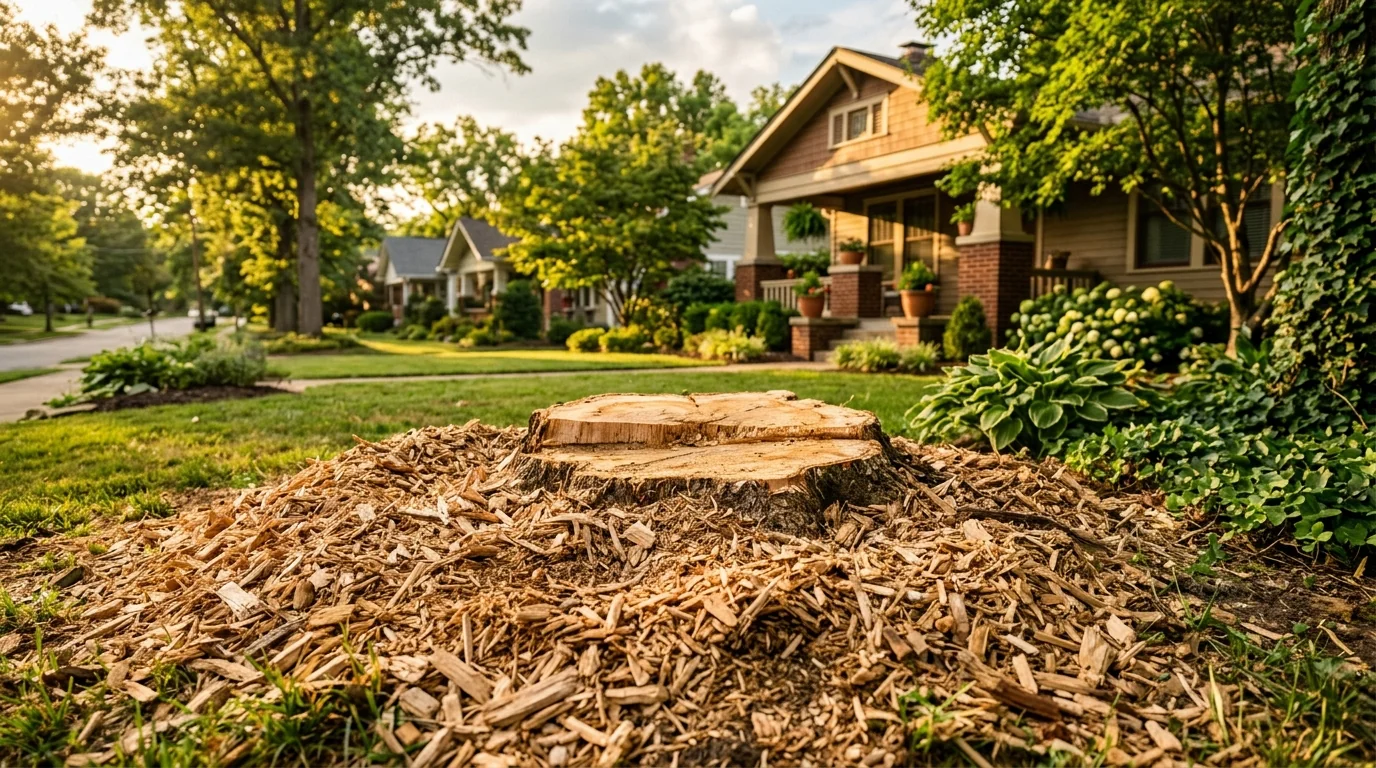
What is stump grinding and when is it the right choice?
Stump grinding is the fastest and most common method for eliminating a leftover tree stump from a residential property. A self-propelled machine fitted with a rotating, carbide-tipped steel wheel is positioned over the stump and worked back and forth in overlapping passes until the wood is reduced to chips 6-12 inches below the surrounding soil surface. The roots are left in place to decay naturally. The result is a filled cavity, a pile of wood-chip mulch, and a yard that can be seeded or sodded within days. For most Knox County homeowners who simply want the stump gone so they can mow without obstacle, grinding is the practical and economical answer.
How stump grinding works mechanically
The grinding wheel on a commercial unit spins at high speed and is lowered onto the stump face, then swept side to side by the operator. The machine chews through the wood in layers, moving progressively deeper with each pass. Larger stumps from mature oaks or the black walnut trees that are common in East Tennessee require more passes and more time. The chips produced fill the void as the wheel descends. A skilled operator can grind an average residential stump and clear the area in under two hours.
When grinding is the right call
Stump grinding fits the job when the goal is cosmetic clearance, when a lawn needs to go back to grass quickly, or when budget matters. It works well on most Knox County lots because the equipment is compact enough to pass through a standard gate opening. Stumps from trees removed after pest damage, including the ash trees Knox County has been losing to Emerald Ash Borer and the hemlocks damaged by Hemlock Woolly Adelgid in the surrounding ridges, are routine grinding candidates. If you plan to replant a tree in the same spot, install a concrete pad, or suspect that roots have grown into a drain line, grinding alone may not be enough.
When an alternative is better
Full stump removal, which uses an excavator to pull the entire root ball from the ground, is worth the extra cost in a few specific scenarios. If you are laying a foundation, pouring a slab, or installing underground infrastructure where roots would interfere, leaving the root system in place to decay over three to seven years is not acceptable. Bradford pear stumps, which are chronic sprouters, are also better candidates for full removal because lateral roots can continue to push shoots even after grinding. Compare the two approaches side by side on the full stump removal service page.
Installation process
Step 1: Site assessment and utility marking (day before or morning of)
Before any machine touches the ground, Tennessee One-Call (811) must be notified at least three business days in advance so underground utilities can be marked. This is not optional. Knoxville’s older neighborhoods, particularly those in North Knoxville and the Fourth and Gill area, often have shallow lateral lines that were laid well before current depth standards. The crew also measures the stump diameter and checks for fence panels, irrigation heads, or buried downspout extensions within the swing radius of the machine.
Step 2: Equipment staging and access
Most residential grinders are track-driven or wheeled units that can fit through a standard 36-inch gate opening. Larger stumps or stumps in tight locations may require a smaller hand-guided unit, which takes more time but causes less lawn disruption. The crew positions the machine and confirms the grind depth requested, typically 6-8 inches for lawn restoration, up to 12 inches if a concrete project follows.
Step 3: Grinding passes
The operator lowers the wheel onto the face of the stump and begins a series of side-to-side passes, stepping down in depth incrementally. Wood chips accumulate in and around the cavity. For a stump with a 16-inch diameter, expect 45-75 minutes of active grinding time. A 30-inch-diameter oak stump can take two to three hours. Surface roots that radiate outward from the base are addressed with additional passes along the root runs, typically to a depth of 4-6 inches.
Step 4: Cleanup and chip management
Once the target depth is reached, the crew rakes chips back into the cavity. Excess chips can be bagged for the homeowner to use as mulch or loaded into the truck for removal, depending on what was agreed at quoting. Clarify this before work starts, as chip hauling is sometimes a separate line item.
Step 5: Backfill and surface finish
Adding topsoil on top of the chips is the final step before seeding. The cavity will settle 2-4 inches as chips decompose over the first season, so slightly overfilling the hole is good practice. The total time from machine arrival to departure for a single residential stump is typically one to three hours.
Stump grinding vs. full stump removal
The practical difference between the two methods comes down to what you plan to do with the space and how much disruption you are willing to accept.
Stump grinding is quieter on the wallet and the yard. The machine footprint is small, the job is done in hours, and the yard can be seeded the same day. The trade-off is that the root system stays underground and takes years to decompose. During that period, the ground above the roots can develop slight depressions as wood breaks down. For a lawn or flower bed, that is a manageable inconvenience. For a patio slab or a new structure, it is a problem.
Full stump removal pulls everything out, roots included. That requires excavation equipment, which means wider gate access, more ground disturbance, and a larger pit to fill and grade. The cost per stump is meaningfully higher, and the yard takes longer to recover. The payoff is a completely clean slate. If you are replanting a tree in the same location, replacing a fence post whose footing was wrapped by roots, or building over the area within the next few years, full removal is the correct choice.
In Knox County, the combination of clay-over-limestone soils and karst geology does affect the math occasionally. Roots that have worked their way into a solution cavity or around subsurface limestone ledges can make full removal significantly harder than a straightforward clay-soil excavation. For stumps in areas with known sinkhole activity, the crew should probe around the root ball before committing to full excavation. In those situations, grinding and letting the roots decay is sometimes the more structurally cautious option.
For most Knoxville homeowners removing a dead ash, a storm-damaged pine, or a Bradford pear, grinding is sufficient.
Stump grinding cost in Knoxville, TN
Stump grinding cost varies by stump diameter, grind depth, site access, and the number of stumps on the visit. Bob Vila reports that stump grinding typically runs $100-$400 per stump nationally, with some contractors pricing by diameter at $2-$5 per inch. This Old House confirms that additional stumps on the same job are often discounted because the mobilization cost is shared.
Local variables that move the number in the Knoxville market:
- Stump diameter. A 10-inch Bradford pear stump costs considerably less to grind than a 36-inch white oak. Most pricing formulas weight diameter heavily.
- Grind depth. Standard depth (6-8 inches) is included in the base price. Going deeper for concrete prep adds labor and machine time.
- Access. If the crew must disassemble a fence panel, carry equipment by hand through a narrow passage, or work in a steeply sloped backyard (common on Knoxville’s ridge-and-valley lots), expect a surcharge.
- Root surface runs. Some stumps, particularly from older oaks and maples, have prominent surface roots extending several feet outward. Grinding those flushes adds time and therefore cost.
- Number of stumps. A batch of six stumps from a storm cleanup is priced differently than a single isolated stump. The per-stump price typically drops with volume.
For a current Knoxville-specific estimate based on your stump count and site conditions, review the stump grinding cost breakdown for Knox County or request a quote directly.
Warranty and what to ask about it
Stump grinding is a mechanical process, not a structural installation, so warranty terms differ from what you would see on a structural install or a cabling system. A reputable crew should stand behind the workmanship. Industry-standard language covers the following for one year: the stump was ground to the agreed depth, visible surface roots within the work zone were addressed, and chips were managed per the agreed scope.
What the warranty does not cover: natural cavity settlement as chips decompose, root sprouts from species prone to regrowth, or any issues arising from utilities that were not marked before the job. Ask specifically whether regrowth response is included. If you are dealing with a Bradford pear or a black locust, both of which are chronic sprouters in Knox County yards, confirm in writing whether a return visit for sprout treatment is part of the price or a separate charge.
Also ask about liability insurance. Any crew operating a high-speed grinding wheel on your property should carry general liability coverage and workers’ compensation. A stone ejected from the grinding zone can reach neighboring property. Verify coverage before work begins, not after an incident.
Permits and engineering in Knox County
Stump grinding itself does not require a standalone permit in Knox County or the City of Knoxville. The permit obligation, where it exists, attaches to the tree removal that precedes it.
For tree removals within the City of Knoxville, permits for protected trees (generally those meeting diameter-at-breast-height thresholds in certain zones) are processed through Knoxville’s Development Services Division. If the tree was removed under an approved permit, that permit number should be referenced when scheduling the stump work.
For unincorporated Knox County parcels, oversight falls under the Knox County Department of Engineering and Public Works. Trees in or adjacent to county rights-of-way may have additional requirements regardless of the stump work itself.
HOA restrictions apply in a large share of Knox County subdivisions. If your neighborhood is governed by an HOA, check whether stump grinding triggers a landscaping change approval, particularly for stumps visible from the street.
For details on how the Knoxville tree services market handles permits, access, and scheduling, the local service area page covers jurisdiction-specific questions. If you are dealing with storm debris from an event like the flooding and wind damage that followed Hurricane Helene’s remnants across East Tennessee in September 2024, documentation for your insurance claim should be assembled before the stump is ground, since the evidence of the original tree failure is destroyed in the process. The Insurance Information Institute’s guidance on fallen tree coverage outlines what adjusters typically look for when evaluating storm-related removal claims.
Working with an ISA-certified arborist before scheduling the grind is worth the extra step if there is any question about the tree’s health history or whether the removal itself was correctly performed. Certification is verifiable through the ISA’s public lookup tool, and it provides the written documentation that both insurance adjusters and permit offices expect to see.