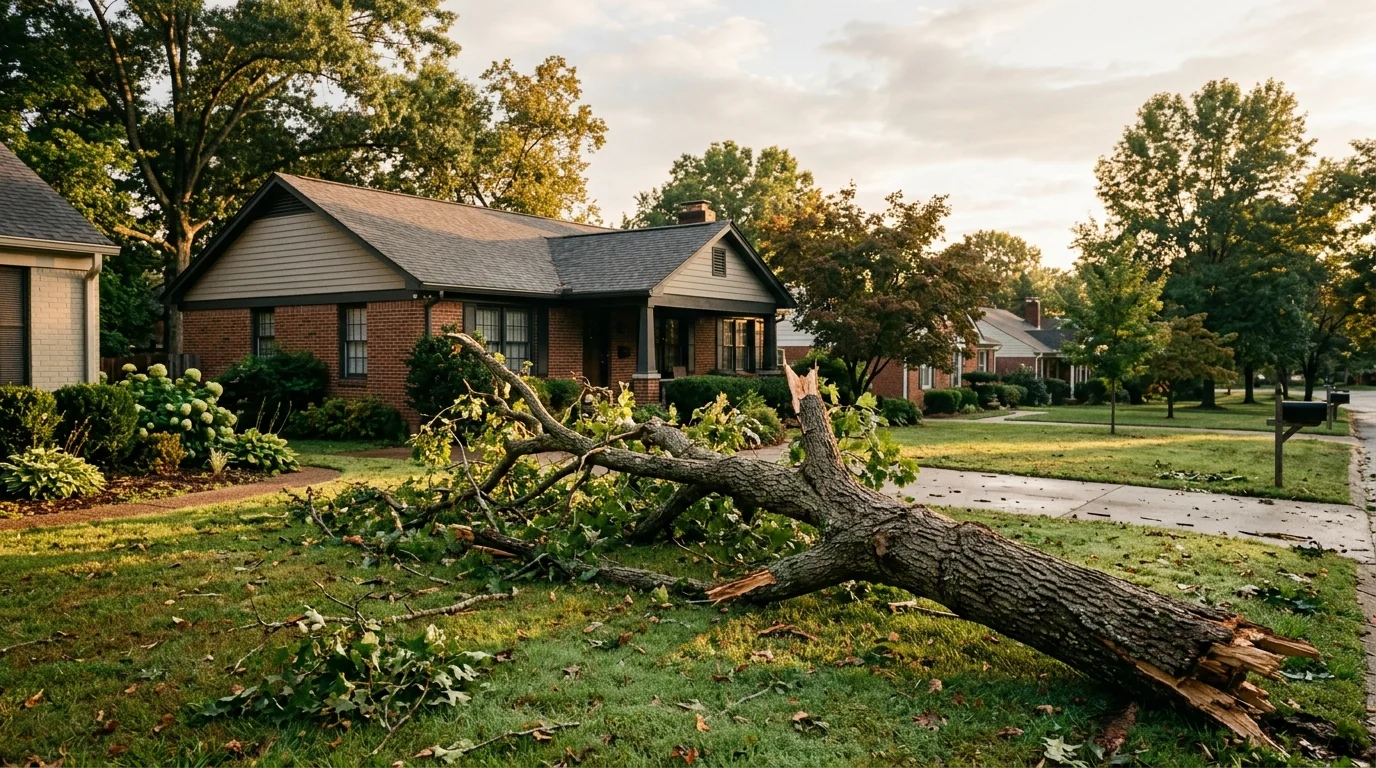
What a Leaning Tree Looks Like (and When to Act)
A leaning tree is the tree health assessment question that most Knoxville homeowners put off too long. The tree was always “a little crooked,” so last spring’s extra tilt gets explained away. Then a heavy rain comes, the clay soil turns soft, and the root plate lifts overnight. Understanding what a lean actually looks like, and what separates a monitor situation from a same-day emergency, can be the difference between a controlled removal and a tree on your roof.
What It Looks Like Exactly
The clearest visual cue is soil heaving or cracking on the uphill side of the root zone, directly opposite the direction the tree is leaning. If you walk to the base of the trunk and see a ridge of lifted earth, or roots that were underground last season now exposed on one side, the root plate is already failing. Secondary signs include bark compression wrinkles on the lower trunk (the tree is literally buckling under its own displaced weight), a crown that has shifted visibly from where it was a season ago, and dead branches concentrated on the side facing the lean.
A tree that has simply grown at an angle over many years looks different. The root flare spreads evenly, bark on the lower trunk shows no fresh compression, and the soil around the base is undisturbed.
Monitor vs. Act Now
Monitor status applies when a tree has a gentle, long-established lean (under 15 degrees), healthy foliage across the full crown, a stable root flare with no heaving, and no structures within the tree’s fall radius. Schedule a tree health assessment with a certified arborist at the International Society of Arboriculture’s ISA Find an Arborist tool within the next few weeks.
Act now if any of the following are true: the lean appeared or noticeably worsened in the past 72 hours; soil is actively cracking or heaving at the base; the tree is within striking distance of your house, a power line, a car, or a neighbor’s property; or you can hear or feel movement at the base when you push lightly on the trunk.
What NOT to Do
Do not attempt to stake or rope a large leaning tree with hardware-store supplies. A tree heavy enough to matter is far beyond what a few stakes can hold, and a false sense of security delays the professional call. Do not prune the heavy side of the crown yourself expecting to “balance” the tree. Improper cuts can introduce decay pathways, and removing weight without addressing the root failure does nothing to stabilize the root plate.
What Causes Leaning Trees in Knoxville, TN
Knox County’s geology and climate create a specific set of conditions that make leaning trees more common here than in many other Southern metros.
The dominant soil type in the Knoxville metro is residual clay and silty clay weathered from limestone, dolomite, and shale bedrock in the Valley and Ridge province (USDA Web Soil Survey, Knox County, Tennessee). That clay has moderate-to-high shrink-swell potential. In a dry stretch it firms up and holds a root plate reasonably well. After the 47.9 inches of annual rainfall Knox County receives (NWS Morristown KMRX, 1991-2020 Climate Normals), and especially after prolonged wet spells, that clay becomes nearly plastic. A root system that was anchored in August can shift in November.
The karst limestone bedrock beneath much of Knox County adds another layer of risk. Solution cavities and subsurface voids mean that in some locations the ground beneath a root zone is not solid at all. A tree can appear stable for decades, then lean acutely when a void collapses or a soil bridge fails. This is a Knoxville-specific hazard that does not exist in most of the Chattanooga or Huntsville markets.
Storm history matters here too. Hurricane Helene made landfall as a major storm in September 2024 and, as its remnants moved inland, caused catastrophic flooding and saturation-driven tree failures across East Tennessee, including Knox County. Trees that survived the wind often failed in the days after, as waterlogged clay gave out under root plates that the storm had already stressed.
Active pest pressure accelerates lean risk as well. Emerald Ash Borer (EAB) is confirmed in Knox County (Tennessee Department of Agriculture). EAB kills the structural wood of ash trees within three to five years, leaving brittle trunks that lean and fall with far less wind than a healthy tree would require. Hemlock Woolly Adelgid has devastated eastern hemlocks throughout the East Tennessee region (USDA Forest Service). Dead hemlocks are top-heavy and poorly anchored once root function ceases. A leaning ash or hemlock near your home is not just a lean problem. It is a structural failure in progress.
The Valley-and-Ridge terrain also channels wind in specific directions through Knox County neighborhoods, meaning some yard positions receive concentrated wind loading that a tree on open flat ground would never see.
Repair Methods That Address a Leaning Tree
Emergency Tree Removal
When root plate failure is active, when the lean is acute, or when the tree is already within striking distance of a structure, emergency tree removal is the appropriate response. A trained crew with the right rigging equipment can take down a leaning tree in sections, controlling where each piece lands even in a tight yard. This is not a job for a chainsaw and a rope.
Tree Cabling and Bracing
For a leaning tree with sound structural wood and a root system that is stressed but not yet failing, tree cabling and bracing can redistribute load and buy years of safe life. High-tensile cables installed between main scaffold branches reduce the swing weight during wind events, lowering the torque the root plate has to resist. Cabling works best when the lean is moderate and caught early. It is not a substitute for removal when the root plate is already lifting.
Crown Reduction Pruning
A heavy, dense crown acts like a sail. On a tree that is leaning because wind loading has overcome a partially weakened root zone, strategic crown reduction pruning removes that sail without removing the tree. Reducing crown weight and wind resistance lowers the mechanical force driving further lean. The ISA’s homeowner guidance on tree care standards supports crown work as a legitimate tool in managing tree risk (Trees Are Good, ISA). Pruning should follow ANSI A300 standards to avoid creating decay entry points.
Stump Grinding After Removal
Once a leaning tree is removed, the stump is not a neutral object. A large stump in a yard that already has clay-over-karst soils can become a tripping hazard, a termite habitat, and an obstacle for any future replanting. Stump grinding reduces the stump below grade and chips the wood into mulch, clearing the site for replanting or landscaping without the years it would take a stump to rot naturally in East Tennessee’s soil conditions.
Typical Cost Range
Costs for leaning-tree work vary more than almost any other tree service because lean introduces rigging complexity. A small ornamental leaning over a flower bed is a very different job from a 90-foot white oak leaning over a roofline. According to Bob Vila’s tree removal cost guide, full tree removal nationally ranges from around $200 for small trees to more than $2,000 for large trees, with hazard and access premiums layered on top for trees near structures. Emergency response and crane-assisted removal add further cost above those baseline figures.
For a broader look at how these costs break down by service type and tree size for the Knoxville market, see the Knoxville tree removal cost guide.
What the Inspection Process Covers
A professional tree health assessment for a leaning tree is more than a quick visual. An ISA-certified arborist will measure the lean angle from the base to the crown tip using a clinometer or digital level, establishing a baseline. They will probe the root zone for soil heaving, root plate movement, and any evidence of karst-related subsidence beneath the anchor roots.
The arborist will also sound the lower trunk with a mallet, listening for hollow sections that indicate internal decay not visible from outside. Any pest signatures (D-shaped EAB exit holes on ash, woolly masses on hemlock branch undersides, tiny beetle galleries under bark on black walnut from Thousand Cankers Disease) get documented. The crown gets evaluated for dieback patterns that indicate whether the tree’s vascular system is still functioning.
All of this feeds into a risk rating and a recommendation: monitor with scheduled re-inspections, cable and prune to reduce load, or remove. A written report is standard practice for any assessment that may involve an insurance claim.
To schedule that inspection, request a free assessment quote and a certified arborist will come to your property.
When to Skip Repair (or Wait)
Not every leaning tree in Knoxville is an emergency. A young tree planted within the last two to three years that has developed a slight lean from wind or uneven watering can often be corrected by repositioning the root ball if it is still small, adding a temporary stake for one growing season, and adjusting irrigation. That is a gardening task, not a tree service call.
A mature tree that has leaned at a consistent angle for more than a decade, with a well-established root flare, no heaving, no decay, and no structures anywhere near its fall radius, may be a monitor candidate rather than a removal candidate. Annual professional check-ins to track whether the lean angle is changing are appropriate. If the angle is stable season over season and the tree is healthy, removal is not automatically required.
Where caution applies is any situation where well-intentioned waiting turns into passive delay. Knox County’s clay soils change their load-bearing properties dramatically between dry and wet seasons. A tree that looks stable in September can shift significantly after the November rains. If there is any doubt, a professional eye is far cheaper than what comes after a tree that was being watched finally falls.
For a full picture of the warning signs that push a leaning tree from monitor to act-now territory, see the Knoxville tree problems reference guide.