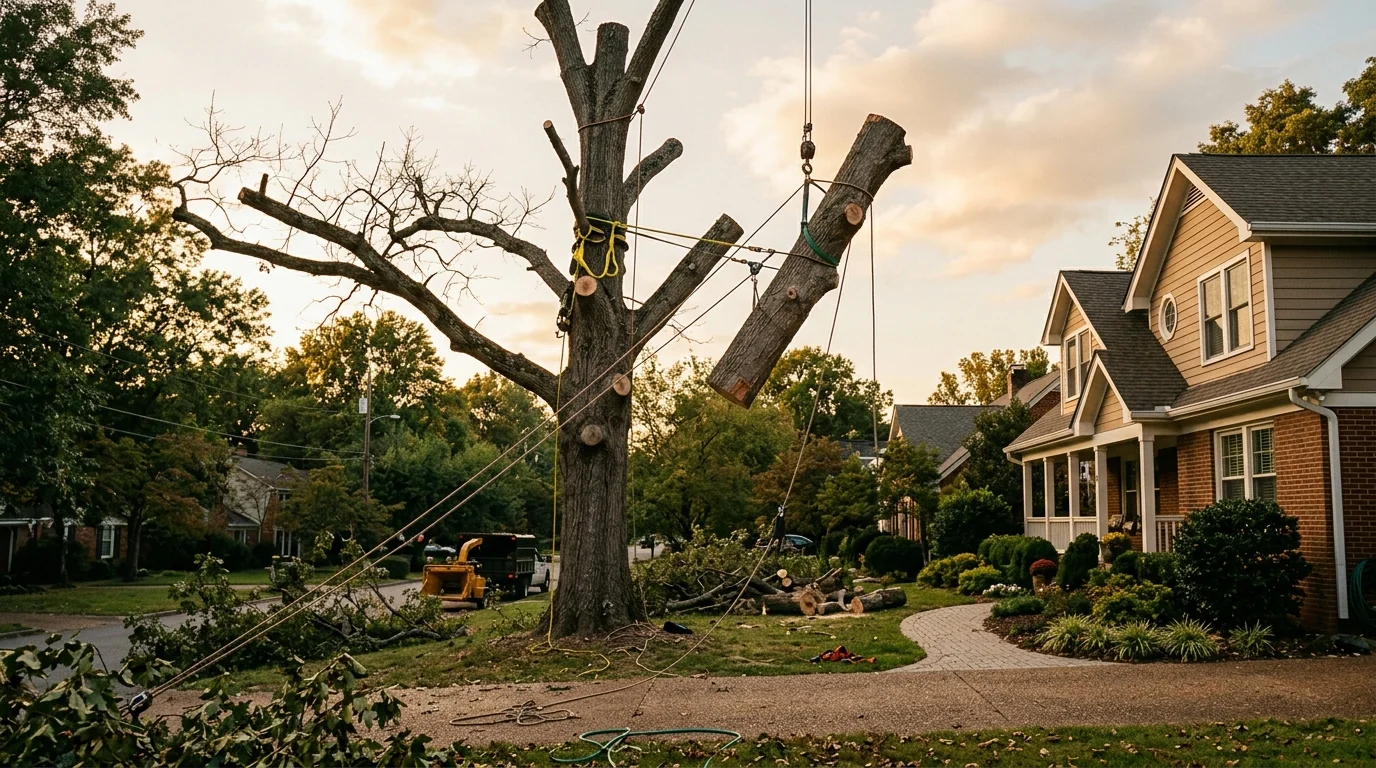
Tree Removal Cost by Tree Size in Knoxville TN
Tree removal in Knoxville costs between $200 and $2,000+ depending primarily on tree height, trunk diameter, and site conditions. Local factors including Knox County's heavy hardwood canopy, karst terrain, and active pest threats like Emerald Ash Borer and Hemlock Woolly Adelgid push many jobs toward the higher end. This page breaks down what each size tier costs and what moves the number.
Updated Jul 14, 2025 · 8 min read
What Tree Removal Actually Costs in Knoxville, TN
The national average for tree removal sits at roughly $1,080, with a typical range of $385 to $1,070. Complex jobs involving large trees, hazardous conditions, or crane access can push totals to $2,000 or more on that same scale.
Knoxville homeowners should treat the lower half of that range as a realistic floor for small, open-site removals and the upper end as a realistic baseline for anything mid-size or complicated. Several local conditions explain why: Knox County’s urban tree canopy is dense with large-caliper hardwoods (oaks, hickories, and walnuts), karst limestone terrain creates uneven, sometimes unstable ground for heavy equipment, and active pest threats like Emerald Ash Borer and Hemlock Woolly Adelgid have left many standing trees structurally compromised and risky to fell. A brittle, beetle-killed ash or a dead hemlock leaning toward a roofline is not the same job as a healthy sapling in an open lawn, even if both measure 40 feet tall.
Get a written quote from a Knoxville tree service before budgeting. Written estimates account for site-specific variables that no cost guide can predict from a distance.
What Drives the Cost of Tree Removal
Tree height. Height is the single biggest pricing variable. Taller trees require more rope work, longer crane reaches, and more cutting passes, all of which add crew hours. Every 10 to 15 feet added to a tree’s height typically adds $100 to $300 to the job cost per Bob Vila’s size-tier breakdown.
Trunk diameter. A wide trunk takes longer to section and generates far more wood volume. Dense hardwoods like Knox County oaks and black walnuts require more chainsaw passes and more haul-off trips than a same-height softwood.
Tree condition. Dead, diseased, or structurally compromised trees cost more to remove safely because they cannot be climbed without risk of limb failure. Emerald Ash Borer casualties and hemlock trees killed by Hemlock Woolly Adelgid often require rigging from a ground-based crane rather than a climber, which adds equipment cost.
Site access. Narrow gates, overhead utilities, structures in the drop zone, and sloped terrain all increase complexity. In tight West Knoxville subdivisions or older in-town neighborhoods like Fourth and Gill, crews may need to hand-carry debris to the street rather than using a chipper truck, which adds labor time.
Crane requirements. When directional felling is not possible, a crane is necessary. Crane mobilization adds roughly $500 to $1,000 before the removal itself begins.
Debris haul-off. Most Knoxville crews include chipping and haul-off in the base quote, but verify this in writing. Log splitting, leaving wood on-site, or requesting specific wood lengths can each change the total.
Stump grinding. Stump removal is almost always a separate line item. Expect $100 to $400 depending on stump diameter, root flare spread, and ground conditions. Knox County’s rocky karst subsoil can dull grinding heads faster than clay-only sites, which some contractors price into their stump bids.
Cost by Tree Size Tier
Small Trees (Under 30 Feet)
Small ornamentals, young maples, dogwoods, and most shrub-sized trees fall here. Typical cost range: $200 to $450 per Bob Vila. Most residential lots in Knoxville can accommodate a small tree removal without special equipment. The main local complication is site access: if the tree is behind a privacy fence in a dense neighborhood, expect the higher end of this range.
Medium Trees (30 to 60 Feet)
This is the most common category for Knox County residential jobs. Medium-height pines, Bradford pears (a structurally weak species common across Knoxville’s older subdivisions), and ash trees killed by Emerald Ash Borer typically fall here. Cost range: $450 to $1,000 per Bob Vila. A dead or dying tree in this range costs more than a healthy one because it cannot be safely climbed, requiring rigging from the ground.
Bradford pears deserve a specific note. They are prevalent in Knoxville’s 1990s and 2000s-era developments and are prone to catastrophic splitting along co-dominant stems, especially after ice loading. East Tennessee’s moderate-to-high ice storm risk (the February 2021 event caused widespread damage across Knox County) means many Bradford pears fail partially before a homeowner schedules removal, adding a hazard premium to the job.
Large Trees (60 to 80 Feet)
Mature white oaks, red oaks, tulip poplars, and hemlocks populate this tier. Knoxville’s Valley-and-Ridge terrain supports old-growth-adjacent specimens in many residential areas, particularly in the hillside neighborhoods east and west of downtown. Cost range: $1,000 to $1,500 per Bob Vila. An eastern hemlock in this size range killed by Hemlock Woolly Adelgid will typically need crane assistance if it overhangs a structure, pushing the total to $1,500 or above.
Very Large Trees (Over 80 Feet)
Knoxville’s mature canopy includes substantial black walnuts, large oaks, and century-old tulip poplars exceeding 80 feet. Removing these trees is complex, almost always requires crane access for any tree near a target zone, and typically runs $1,500 to $2,500 or more per Bob Vila. Black walnuts carry particular significance locally: Knoxville was the site of the first eastern U.S. detection of Thousand Cankers Disease in July 2010 (Tennessee Department of Agriculture), and infected black walnuts decline over two to three years, becoming large hazard trees requiring professional removal.
For an overview of all tree service options, see the Knoxville tree removal cost hub.
Dead Tree Removal and Hazardous Tree Premiums
A dead tree is not simply a cheaper removal. Dead wood is unpredictable under chainsaw load, limbs detach without warning, and trunk wood may be punky and unable to support rigging hardware. Knoxville’s pest landscape means a large share of dead tree removals involve EAB-killed ash (which become brittle within a few years of infection) or HWA-killed hemlocks.
Hazardous tree removal typically carries a 15 to 30 percent premium over a same-size healthy tree removal, reflecting the additional rigging, crew time, and equipment requirements.
For dead or hazardous trees close to structures, confirm that the crew carries a minimum of $1 million in general liability coverage and verify their ISA-certified arborist credentials before work begins.
Insurance and Financing
Homeowners insurance covers tree removal in a specific and limited set of circumstances. According to the Insurance Information Institute, a standard policy typically covers removal costs when a tree falls and damages a covered structure (roof, fence, attached garage). It does not cover removal of a standing dead tree, a tree that fell but missed the house, or proactive removal of a tree that poses a future risk.
Knoxville-area homeowners should note that storm events triggering coverage are more common than in many markets. Hurricane Helene’s remnants (September 2024) caused wind and saturation-driven tree failures across Knox County, and East Tennessee’s documented ice storm pattern (including the February 2021 event) frequently sends trees through fences and onto roofs. These events are the primary insurance-covered removal scenarios in this market.
For removal jobs that fall outside coverage, two financing options are worth considering:
A home equity line of credit (HELOC) draws on your home’s equity at a variable rate, making it practical for larger removal projects. Rates fluctuate with market conditions, so get a current rate from your lender.
Contractor financing is offered by many Knoxville tree services, typically through a third-party lender at 0 to 18 percent APR depending on creditworthiness. Compare the total cost of financing against the HELOC rate before committing, since deferred-interest contractor plans can carry steep back-end charges if the balance is not cleared in the promotional period.
Permits and Engineering
Knox County and the City of Knoxville each have tree protection provisions that may require a permit before removal, particularly for trees above a defined caliper, trees in riparian buffers, or trees visible from a public right-of-way. Permit fees for residential projects generally run $25 to $75, though this varies by jurisdiction and project type. Confirm with the appropriate codes office before scheduling.
An ISA-certified arborist inspection report is not the same as an engineering letter, but it serves a similar role for insurance claims and neighbor disputes. Most Knoxville arborists charge $150 to $300 for a formal written assessment. If a tree overhangs a shared property line, a written assessment documenting the hazard condition is valuable documentation before and after removal.
For crane-assisted or specialty tree removal services, no engineering stamp is typically required on the removal itself, but if the tree has damaged a foundation or structure, a structural engineer’s review of the underlying damage is a separate cost.
Getting an Accurate Quote
A written quote from a Knoxville tree service should include: a line-item scope listing the specific trees to be removed, stump disposition (grind or leave), debris haul-off terms, and a certificate of insurance with your name as the certificate holder.
Red flags in any quote include: verbal-only pricing with no written document, pressure to sign on the same visit, a scope that omits debris removal or assumes you will dispose of wood yourself, and no mention of ISA or TCIA credentials. Reputable Knoxville crews will point you to their TCIA accreditation or ISA certification without being asked.
A low bid that omits crane access for a tree that clearly needs it, or that does not account for stump grinding, will not look competitive once the add-ons appear. Insist on a scope that prices the complete job before work begins.
Request a written quote for your Knoxville tree removal and compare it against the size-tier ranges on this page to confirm you are seeing a realistic number for your specific tree and site.
Cost figures sourced from Bob Vila. Insurance coverage guidance from the Insurance Information Institute. Pest and disease data from Tennessee Department of Agriculture and University of Tennessee Extension. Local climate data from NWS Morristown (KMRX).
Free written estimate
Worried about a tree? Get a free estimate.
On-site assessment and a written estimate. Same-day for emergencies. No obligation.
Questions
Tree Removal Cost by Tree Size in Knoxville TN FAQs
How much does it cost to remove a small tree in Knoxville?
Does tree size alone determine the price?
Will homeowners insurance cover tree removal in Knoxville?
Do I need a permit to remove a tree in Knoxville?
What does crane-assisted tree removal cost in Knoxville?
How do I know if a dead tree qualifies as hazardous?
What red flags should I watch for in a tree removal quote?
Free estimate
Talk to a Knoxville tree pro
On-site assessment and a written estimate, often same day. No obligation.